Even the Experts Need to Practice

Stop yourself from “eastwooding”

Imagine … you are an 82-year old actor accustomed to performing in front of live audiences your entire professional career. Your experiences aren’t limited to acting but you’ve also acheived elite status as an award-winning director. Two weeks ago most of us witnessed what happens when you don’t prepare for a presentation and decide to “wing it”.

Over the weekend, in an interview with a local newspaper, Mr. Eastwood recanted the events leading up to his performance at the Republic National Convention  – http://usat.ly/QrXJt1.

Now, I’m fairly confident no one following my blog, or any of our peers in the channel, can hold a candle to Mr. Eastwood’s extensive public speaking resume. However, even with his storied career his actions clearly prove you MUST always practice, practice, practice. It is so essential to be impeccable with your words and test your ideas/thoughts before you go live.

Even if, as Mr Eastwood learned, you’ve been performing presentations for years you still need at least one dry run. Take time to walk through your presentation with a co-worker, a friend or family and I guarantee you will be rewarded by your efforts.

Inspired by Feedback

I’m inspired to revisit my blog after a short hiatus.

Last week I had the opportunity to reacquaint myself with my public speaking skills. It had been about two months since I was on a stage and it felt revingorating to garner smiles and head nods. I spoke on a topic many sellers are intersted in today, how to accelerate a sales cycle.

I’ve considered myself a good public speaker, however I was overwhelmed when an audience member complimented me by saying I remind him of Seth Godin http://www.sethgodin.com/sg/. Hopefully a reference to my enthusiastic delivery, creativity and less about our matching hairstyle.

I look forward to sharing ideas, on a more frequent basis, so you can improve your sales and presentations skills.

Leverage Your Inner Boy Scout

Be prepared for anything.

About a month ago I dusted off my camping gear and drove to Moab, UT for a 3-day camping weekend. The first camping trip of the season always feels clumsy and rusty primarily because I’m not confident I packed everything I need for the trip. What helps alleviate my worries is – maintain a camping box where I store most of my gear and I assume the worst can happen at any moment.

How does this relate to your demo preparations?

Many sales teams travel to a prospect’s location with only their laptop in tow. Or worse, they rely on an internet connection to connect to their demo environment back in the office. If you plan for the worst, and you should because everyone knows the inevitable will happen, you will be prepared for any surprises.

A great tip for any sales team is to build a demo box, similar to my camp box, and include items which you may need to save your hide in the worst situation.

Suggestions to include in your demo box:

  • A local installation of your software (it’s always wise to have a backup plan)
  • Presentation clicker
  • VGA extension cord (enables you to position yourself anywhere in the room)
  • Power extension cord + surge strip
  • Back up projector
  • Batteries
  • Flipchart + markers

Be prepared for anything.

What Did They Just Say?

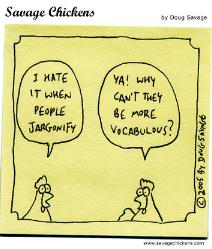
Jargon is defined as the language, or vocabulary, peculiar to a particular trade. To an audience these are typically not understood and is referred to as unintelligible language.

Be impeccable with your words.

Recently, I kicked off a seminar hosted by one of our local business partners. The session targeted new ERP prospects and the room was filled with bright eyes. The presenter did his typical overview presentation which garnered plenty of head nods during the session. About midway through his presentation I recognized his ability to avoid using JARGON. As questions arose from the audience, instead of answering with the name of the module or tool which addressed the issue, he simply explained in lay terms how his team could solve the challenge.

Too often presenters, especially in technology, assume an audience knows exactly what they are referring to when use words or phrases such “web parts”| “SaaS” | “cloud” | “application framework” | “intergration manager” | “content management” |

You do yourself a tremendous disservice by alienating your audience each time you use JARGON in your speech.

Be impeccable with your words.

Here’s an idea – take your presentation home and practice. Test your words on family or friends. If they look at you with the same twisted neck turn your dog gives you when you make a funny noise … it’s most likely JARGON.

What is the Theme of Your Presentation?

LAST month I led a 90-minute, Deep Dive session at Microsoft’s Convergence. The session was designed for a 100-level audience spanning topics from CustomerSource, Dynamics Marketplace to SQL Report Builder and PowerPivot. According to the post-event report, the session drew just under 100 people.

MY THEME:

I opened with a story about my first job; at 15 I began my career as a DJ for a mobile music service on Long Island. Then, I segued into the evolution of the music industry over the past 20+ years. From LPs to CDs to MP3s to iPods to Xboxes. Today ERP software, like music,  has grown more complex than ever. While we have so much more access to resources, modules and services … finding, learning and implementing presents another set of challenges.

SO WHAT?

Creative themes are extremely effective ways for people to remember you and your pitch.

The reason for today’s “TIP” is that almost 30 hours after I delivered my session, a woman sitting across from me at lunch on Wednesday   afternoon turned to her co-worker and said ‘see that guy, he was a DJ in New York, when he was 15 years old’. It’s amazing if you consider how many people she met during that span at Convergenc and she still remembered my story/theme from the session she attended.

Consider how many sales organizations, or vendors, your prospect meet. My guess is much fewer than 100 people. What are you doing to ensure your prospect remembers you when you leave the room?

And remember, if you have a creative idea but you are not confident it will resonate with a prospect, test it on a friend, spouse or a co-worker.


Opening Day in the Mile High City

LAST Monday afternoon was opening day for the Colorado Rockies. It was a spectacular day and attending the home opener (or at least soaking up the downtown festivities) has become a rite of passage in the mile high city.

About PREPARATIONS

During the game I began thinking about spring training. Spring training is the preparatory period leading into the baseball season. It’s about practicing the common tasks these professionals will execute every day for the next 5 – 6  months. Even the veteran players who have been playing for 10+ seasons approach spring training as if this were their rookie season. Fielding ground balls, catching fly balls and playing a game of pepper.

About ORGANIZATION

It’s also fascinating to consider the effort and details a manager puts forth to compile a roster for each individual game. 162 games over the next several months. Every morning, before game time they sit at their desk to organize their thoughts and ideas on how to tackle the upcoming opponent. “Who is our starting pitcher?”, “Who will bat 3rd?” … yadda yadda yadda

Today’s Tip

Today’s tip is about preparation and organization. I consider every one of you successful and seasoned professionals. You’ve been selling software and conducting discovery calls for many, many years.

But … do you approach each opportunity uniquely as if you were the head coach of your favorite baseball team? Before every call do you plan out your questions and strategy?

For example, how are your discovery questions organized for the prospect and their industry? Do you begin your discovery with a blank sheet of paper or do you have a “roster” of questions already prepared prior to your first call.

During the discovery workshops we provide organizational tools to help you capture key, pertinent information for each opportunity. It’s an extremely efficient way to get organized. Also, having your questions pre-written saves time during note taking and improves listening.

Whether you leverage the tools provided during the workshop or you have your own pre-defined question sheet. Use it. It’s a simple way to prepare and get organized.

Good luck during the remainder of the quarter and win one for the gipper.