
Leverage AI for a Competitive Advantage

For years, virtually every evaluation of a new business application, such as a CRM or ERP, would include a checklist of features published by the customer or the external evaluation consultant. These features were compared, contrasted against competitors, and prospective customers would begin to assess which solution best matched their business needs to make an informed decision. Instinctively, the sales team would stress over every feature in a Request for Proposal (RFP) to ensure they could address the requested capabilities. The sales team’s primary goal was to persuasively educate the customer on the favorable balance of checklist items, “we do these six, and they do five,” thus convincing prospects to choose the right solution.

With every new innovation from the Microsoft platform, our partner-facing teams at Microsoft try incredibly hard to evangelize how our platform innovations provide a tremendous business opportunity for Microsoft Dynamics. These technological innovations, when embraced, helps partners to avoid the feature pitfall, the feature-comparison example above, and show the world how to make themselves unique to their competition. We have a great story to tell with Dynamics.

Today’s innovation topic is Artificial Intelligence, “the democratization of AI”, how Dynamics partners can distinguish themselves from their competition and further strengthen the trusted relationship partners bring to customers.

A BRIEF HISTORY OF BUSINESS PROCESS AUTOMATION

We all recognize how the structured “systems” or ERP and CRM offer tremendous benefits to companies by automating business processes and empowering employees to become more productive in their jobs. It’s on display when demonstrating, to a new user, the reduction of “clicks” required to complete a task. It could be an email notification requesting approval based on an event that occurred, or the automation of a supply chain ensuring products are manufactured, processed, packaged and shipped to customers to satisfy demand.

The primary objective of these systems is to record transactions, record business processes. They capture fragmented data kept in silos where someone then designs a report, and decision makers use it to make decisions on the future of their business. This reactive manner in which most companies operate today, review the past and guess what will happen in the future, is typical yet limiting.

HOW IS MY BUSINESS DOING vs. HOW DID WE DO?

Imagine a scenario where, through embedded artificial intelligence applications, decision makers leverage predictive insights based on data to take actions on advice. Imagine the same executive board room leveraging the vast amount of data a company has in storage, aligned with their business applications, to improve decisions and the future of a company.

EXAMPLES OF AI WITH DYNAMICS 365 APPLICATIONS

There are a growing number of data model examples where artificial intelligence is embedded in Dynamics 365. For instance:

  • Sales representatives can predict which customers will most likely make a purchase
  • Field technicians can predict equipment failures before they occur
  • Accounting managers can predict, before posting a transaction, whether a customer is likely to pay on time

These are just a few examples we will review during our upcoming technical community call.
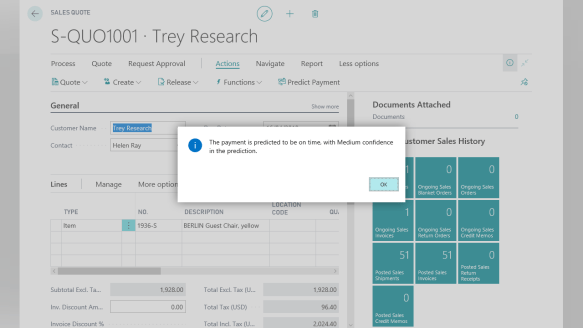
Late Payment Prediction Screen

Late Payment Prediction while entering a Sales Quote

There isn’t a single ERP or CRM software provider on the planet who doesn’t handle debits/credits, transactions, quotes, orders, and reporting. However, not many organizations can deliver the innovative solutions a Dynamics partner can with the power of the Microsoft platform.

If you are a Microsoft partner, make sure you join us for the next Business Applications Monthly Technical Community call to learn more.

Talk the Talk

One of the most critical steps during any ERP or CRM sales cycle is the research you perform prior to the initial contact with a prospect. Good pre-discovery can significantly streamline a sales cycle while contributing to building your relationship as a trusted advisor.

Sales teams who dedicate at least 30 – 60 minutes to learn about an industry they aren’t intimately familiar with, often put themselves in a strategic advantage over the other competitive “horizontal” sellers.

The reason is, individuals and companies alike, prefer to invest in experts. It’s a fact. Look at your own personal, consumer buying patterns. When given a choice between saving a few dollars to engage with a business who may understand your needs versus spending a premium to invest in a product and service that understand exactly your specific need. The majority of the time people lean towards the premium option.

Before your initial call you should know – What are the key metrics in the industry? What are the top three priorities for the CFO? What current trends and business opportunities drive the prospect’s industry?

How do you get started? In addition to the traditional research avenues – a company website, Bing or Google, LinkedIn, etc. there are several industry tools to aid you in becoming proficient and speaking your prospect’s “language”.

Three tools I rely on and recommend to partners, in order of preference:

Prior to my post I contacted all three organizations to learn about discounts available to Microsoft partners. While they exist, the reps weren’t forthcoming on what discounts they provide to Microsoft partners. However, when you call remind them you are a MSFT partner and learn more.

Opening Day in the Mile High City

LAST Monday afternoon was opening day for the Colorado Rockies. It was a spectacular day and attending the home opener (or at least soaking up the downtown festivities) has become a rite of passage in the mile high city.

About PREPARATIONS

During the game I began thinking about spring training. Spring training is the preparatory period leading into the baseball season. It’s about practicing the common tasks these professionals will execute every day for the next 5 – 6  months. Even the veteran players who have been playing for 10+ seasons approach spring training as if this were their rookie season. Fielding ground balls, catching fly balls and playing a game of pepper.

About ORGANIZATION

It’s also fascinating to consider the effort and details a manager puts forth to compile a roster for each individual game. 162 games over the next several months. Every morning, before game time they sit at their desk to organize their thoughts and ideas on how to tackle the upcoming opponent. “Who is our starting pitcher?”, “Who will bat 3rd?” … yadda yadda yadda

Today’s Tip

Today’s tip is about preparation and organization. I consider every one of you successful and seasoned professionals. You’ve been selling software and conducting discovery calls for many, many years.

But … do you approach each opportunity uniquely as if you were the head coach of your favorite baseball team? Before every call do you plan out your questions and strategy?

For example, how are your discovery questions organized for the prospect and their industry? Do you begin your discovery with a blank sheet of paper or do you have a “roster” of questions already prepared prior to your first call.

During the discovery workshops we provide organizational tools to help you capture key, pertinent information for each opportunity. It’s an extremely efficient way to get organized. Also, having your questions pre-written saves time during note taking and improves listening.

Whether you leverage the tools provided during the workshop or you have your own pre-defined question sheet. Use it. It’s a simple way to prepare and get organized.

Good luck during the remainder of the quarter and win one for the gipper.