What’s the BIG Deal about Cost Justification

How important do you feel it is to provide a decison maker with a business case justification when pitching your software and services?

The following graph was captured during a survey conducted by Forrester Research and presented during a recent SQL Server webcast. I agreed with the presenter and firmly believe delivering a solid business case to any prospective buyer (big or small), regardless of the solution, is your key differentiator.

Occassionally I’ll meet a sales team who disagrees with me on the importance of selling with ROI (return on investment) or Payback. One sales professional claimed this method of selling is “only for the big dogs”.

I contend that in today’s selling environment you are not just competing against other software providers but other capital investments. Often times the sales team with the greater, more credible cost justification, is rewarded with the winning decision.

What are your experiences? When were you successful and when did it backfire on you?

Leverage Your Inner Boy Scout

Be prepared for anything.

About a month ago I dusted off my camping gear and drove to Moab, UT for a 3-day camping weekend. The first camping trip of the season always feels clumsy and rusty primarily because I’m not confident I packed everything I need for the trip. What helps alleviate my worries is – maintain a camping box where I store most of my gear and I assume the worst can happen at any moment.

How does this relate to your demo preparations?

Many sales teams travel to a prospect’s location with only their laptop in tow. Or worse, they rely on an internet connection to connect to their demo environment back in the office. If you plan for the worst, and you should because everyone knows the inevitable will happen, you will be prepared for any surprises.

A great tip for any sales team is to build a demo box, similar to my camp box, and include items which you may need to save your hide in the worst situation.

Suggestions to include in your demo box:

  • A local installation of your software (it’s always wise to have a backup plan)
  • Presentation clicker
  • VGA extension cord (enables you to position yourself anywhere in the room)
  • Power extension cord + surge strip
  • Back up projector
  • Batteries
  • Flipchart + markers

Be prepared for anything.

Predict and Prove


One of my favorite tips is challening a presenter to “predict and prove”.

Everyone’s heard the reference “tell ’em what you are going to show and then show em”. Or, if you’ve attended a Demo2Win workshop you’ve heard me coach the Tell-Show-Tell methodology.

Following this construct for any demo is extermely essential in providing your audience with a roadmap of where you are taking them before your show software. By opening your demo with a prediction you are providing the roadmap for your audience to follow. Then, your demo becomes the proving ground for your prediction. It’s a very simple and easy structure to remember and your audience will reward your efforts with head nods.

Challenge yourself on your next demonstration and attempt to “predict and prove” your message.

What Did They Just Say?

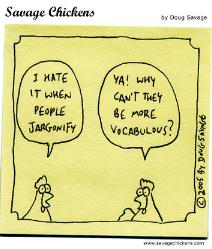
Jargon is defined as the language, or vocabulary, peculiar to a particular trade. To an audience these are typically not understood and is referred to as unintelligible language.

Be impeccable with your words.

Recently, I kicked off a seminar hosted by one of our local business partners. The session targeted new ERP prospects and the room was filled with bright eyes. The presenter did his typical overview presentation which garnered plenty of head nods during the session. About midway through his presentation I recognized his ability to avoid using JARGON. As questions arose from the audience, instead of answering with the name of the module or tool which addressed the issue, he simply explained in lay terms how his team could solve the challenge.

Too often presenters, especially in technology, assume an audience knows exactly what they are referring to when use words or phrases such “web parts”| “SaaS” | “cloud” | “application framework” | “intergration manager” | “content management” |

You do yourself a tremendous disservice by alienating your audience each time you use JARGON in your speech.

Be impeccable with your words.

Here’s an idea – take your presentation home and practice. Test your words on family or friends. If they look at you with the same twisted neck turn your dog gives you when you make a funny noise … it’s most likely JARGON.